
Maple Syrup
And the Philosopher's Loop

This is round #2 of the newsletter. The last publishing was about Victorinox and how my mom finances that company. If you haven’t read it yet, check it out here.
Round #2, let’s go.
Blueberry pancakes
I met my wife in 2020, during Covid.
You know what, I’m just going to go out and say it; I know I shouldn’t, but what the heck. Covid did good for me. I know, I know, I know that’s a crazy thing to say, and I know a lot of people died…. but maybe (as a red-headed comedian once said). Look, Covid either changed your life for the better or for the worse. I was in the getting better group.
After we met and started spending more time together, she would often (often = almost every morning) make these incredible blueberry pancakes for breakfast. You can ask my friends, but I would send them pictures of the pancakes daily and ask them: “Isn’t she just incredible?” As my love for my wife grew, my hate for the maple syrup bottle grew with it. I never really paid attention to maple syrup, let alone its bottle. You see, growing up, we just had these plastic bottles, a dark brown colored one for chocolate and a mocha-colored one for maple syrup, which apparently, as I researched for writing this newsletter, is not even maple syrup but fructose corn syrup or brown sugar. It’s not that I was not aware of the regular bottles; I didn’t get to engage with them before; we knew of each other; we just never really made an introduction. You see, growing up in a family of six, you buy stuff in bulk; these fancy two drops of maple syrup bottles were just not economical.
Why did I hate these bottles so much? Like ketchup bottles, the cap would also always get dirty, and when you eat, you’re not always in the mood to get messy. You see, that’s why you have a fork and knife. Yes, yes, yes, of course, you can wipe your hand, but it’s annoying. Why couldn’t they design a cap you can easily open without getting a reminder of the ketchup you had three months ago? First-world problems, right? Maple is the same; only the cap takes it one step further. It plays hard to get. After you use it for a while, it basically refuses to open up. What’s unique about maple syrup bottles is that there are actually different types of caps, but they all have their flaws. If you stick to the end, I’m actually going to share two tips on how to solve this. To add to the crappy cap, the bottle itself has this useless tiny ring that only babies can put their fingers in it. Knowing my baby’s motor skills, the maple syrup and its bottle won’t survive long.
So, I’m left with the question: why did they design the bottles like that?
Maple syrup and the Philosopher's ring
So, how do they make the bottle?
Industrial glass bottles for such products follow a molded glass process, also known as the blow-glass process, and they have nothing to do with cocaine.
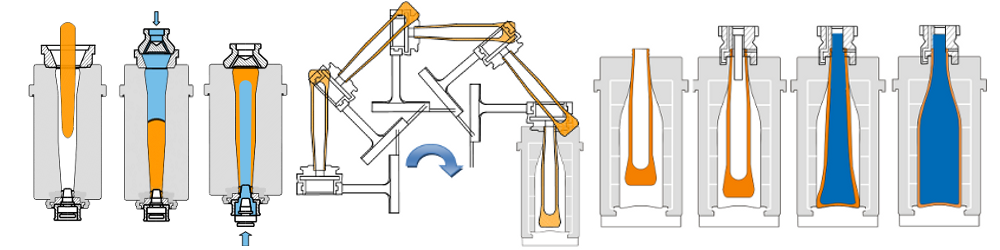
The bottles are produced using one of two methods:
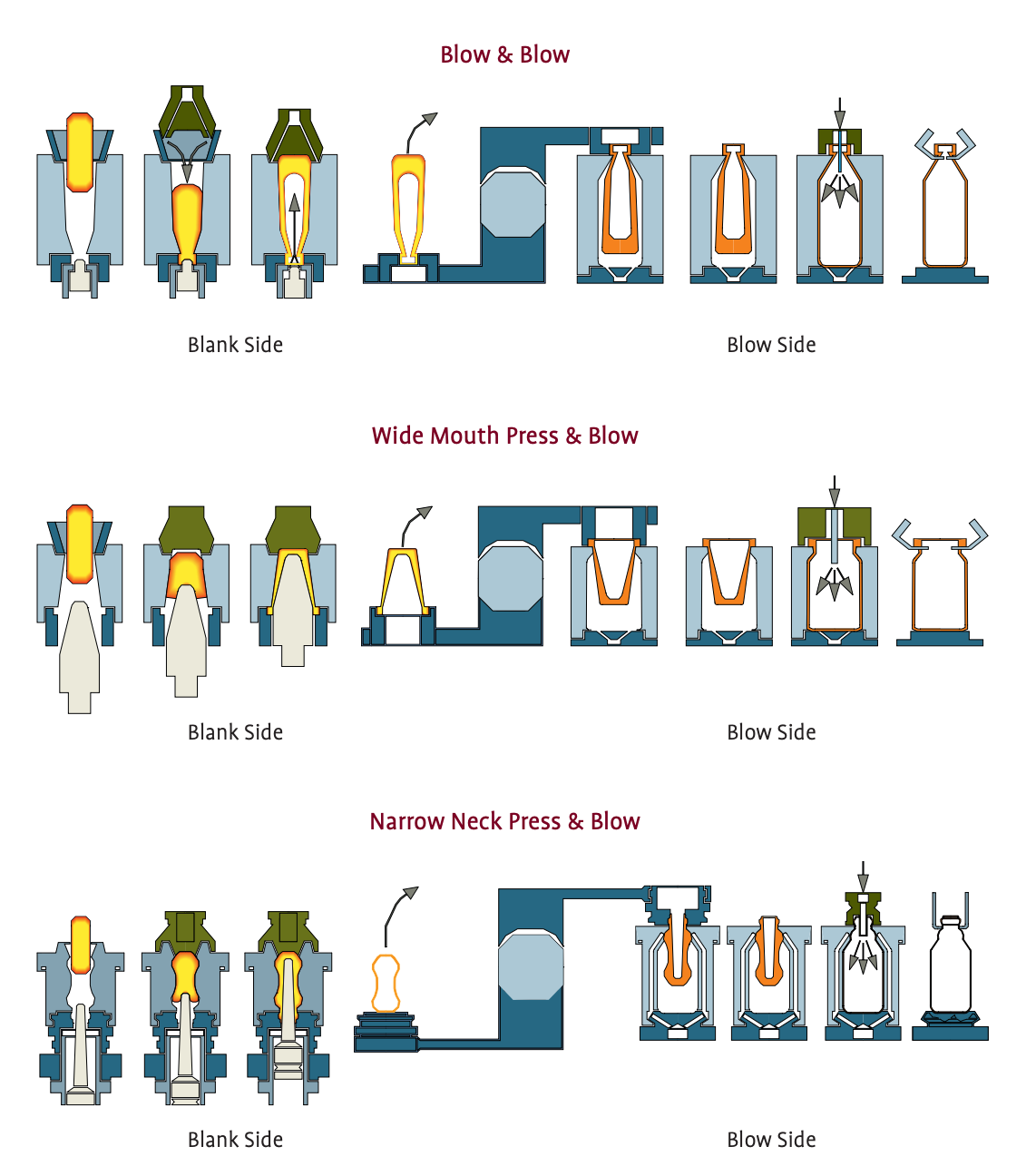
Blow and Blow Process
Press and Blow Process
In the first one, hot and compressed air is used to shape the hot gob (liquid glass drop) into a parison (a rounded mass of glass). This makes the neck and body of what will later be the final bottle. The parison is flipped quickly to the other side of the molding machine, where more hot air is blown through it to give it the final desired shape.
This video shows how the flipping works. It's pretty cool to see. Next time you’re having a Coke from a glass bottle (which you should) because it is scientifically proven to taste better, you can appreciate the bottle itself. You can also watch this video to get the semi-automatic version of this process. The blow and blow methods are best used for glass bottle manufacturing, which requires bottles with different neck thicknesses.
In the second method, which is also the most commonly used method in glass bottle manufacturing, the plunger (or needle in the feeder) forces molten glass through an orifice ring to form a glass gob. It is first inserted into the gob, and only then is the air directed into the created cavity to quickly transform the gob into a parison. This is the method you use when you want to control the shape of the bottle mouth. This method is typically used for manufacturing wide-mouth bottles and jars as their size allows the plunger into the parison.
Actually, on Alibaba, I found suppliers selling maple syrup bottles for $0.18 a piece for the standard ones and $0.12-0.40 a piece for these funny maple leaf-looking ones. That's not bad. So, if you want to commit to buying a gazillion bottles, you can actually get a pretty good bargain; what you’ll do with them is a different question.
The Philosopher's Loop
Let’s talk about that useless loop for a second.
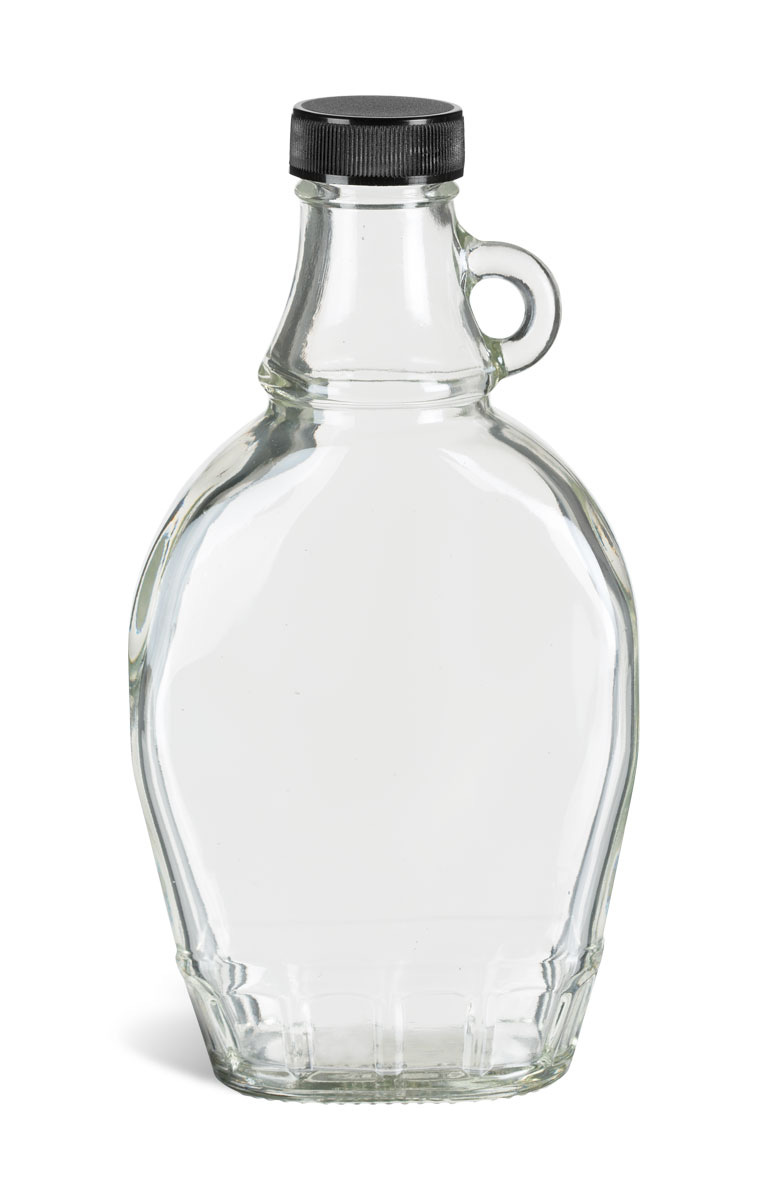
Here is where it gets murky/ sticky - you choose the maple syrup pun. There are two explanations. Both of them make sense. Both are unimportant → because we’re still stuck with that stupid ring, but if we need to hate on someone, at least we’ll have a name. I’ll give you both options; you pick which one you want to brag about around a dinner table.
Version 1: The bottles were shaped as an homage to earthenware (glazed or unglazed nonvitreous pottery). Back in the day (when exactly, not clear, but probably before the 20th century), maple was stored and transported in these heavy old ceramic containers. At the time, this handle, as you can see below, was actually useful for lifting and pouring the syrup. Some argue that this is actually a remnant of the old days and gave the bottle a nostalgic feel; knowingly, it is completely nonfunctional. That said, many of the plastic containers you can find today on the shelf actually resemble these old-school jugs. As we’ll see later, it might actually not be a good thing.
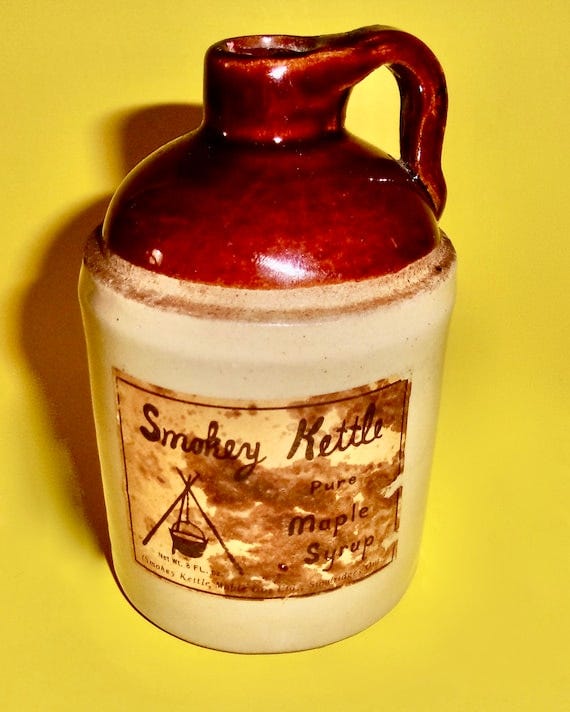
Version 2: Although version 1 makes sense, we can’t really tell if it’s true. What we can say for certain is who first designed and manufactured the bottle, who did so, and when it was first used for selling maple syrup. This maple historian did an incredible piece about this; I’ll try to summarise it. Brooks D. Fuerst of Ohio was awarded the design patent for the bottle in 1951 after applying for the patent in 1949.

Brooks Fuerst (1905–1998) designed glass bottles and jars for food and liquid packaging. He worked extensively with the Owens-Illinois Glass Company and the Libbey Glass Company, both based in Toledo, Ohio—often referred to as the “Glass Capital of the world,” or at least of Ohio. And no, they did not employ children.
The design for the syrup flask, featuring a small handle on the neck, was given the uninspiring title “jug or the like.” The original design included a handle that was not rounded but more angular. Brooks Fuerst later assigned the patent to the Owens-Illinois Glass Company.
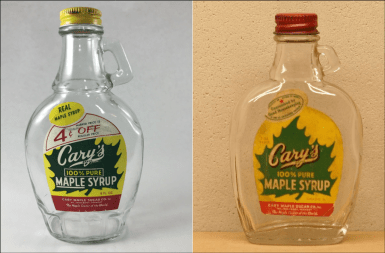
This design was first used in 1950 by the Cary Maple Sugar Company of St. Johnsbury, Vermont, in 2-ounce, 8-ounce, and 24-ounce sizes.
This was not the first design for a maple syrup bottle by a Fuerst. Brooks’s older brother, Edwin W. Fuerst (1903-1988), designed a similar bottle 15 years earlier. Design patents were then, and still are, protected for 14 years.

The patent for Edwin W. Fuerst’s design was applied for in 1932, and formal approval was obtained in 1933. As with the 1951 syrup flask, the patent was assigned to the manufacturer, Owens-Illinois Glass Company. Again or first (chronologically speaking), this design was first used by the Cary Maple Sugar Company, this time in 2, 8, 12, and 24-ounce sizes.
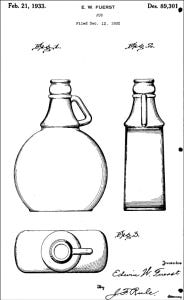
Edwin Fuerst’s 1933 syrup bottle design was named “Design for a Jug.” It had a rounder shape to the body than the 1951 bottle and also featured a virtually identical, small, seemingly useless angled handle at the neck.
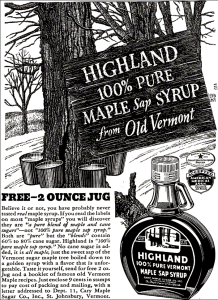
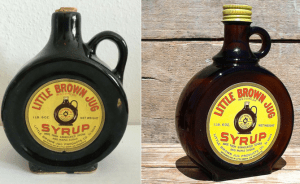
Edwin’s 1933 design resembled another bottle introduced in the 1930s of Little Brown Jug syrup out of St. Louis, Missouri. When their Jug blended syrup was introduced in 1921/1922, it came in a ceramic container with a large loop handle on the shoulder. That design was patented by Joseph Klein in 1922. Around 1934, the Little Brown Jug Products Company shifted to a brown glass bottle in a design that was similar to their earlier ceramic design, with some notable differences added, which happened to make their glass jug very similar to the 1933 round jug of Edwin, such as a round loop handle on the neck and a thick glass ring or ridge at the juncture of the neck and shoulder.
The maple industry used the 1951 design in the sixties and seventies, but it was limited to large packing companies with national sales and shelf space in grocery chains. In the 1980s, with the growing appreciation of specialty glass containers, this design became popular with individual maple producers. In the mid-1990s, the handle design changed from an angular shape to the current rounded form, marking the conclusion of the debate on which loop design was less practical. Everyone lost.
Why did the two brothers design the bottles the way they did? Probably, they wanted to torture us, the living, long after they were gone. One could argue the mission was accomplished.
Does the material of the container matter?
Well, apparently, yes. I’ll explain it in more detail later on, but grading is a big thing in the maple industry. Well, which one is it? We have glass, plastic, and metal (old-school tins were the way to go back then; some still use them today).
Why use one and not the other? There are many things to consider, such as ease of transportation and storage by the end consumer, but the most important is the maple grade. A study from 2020 done by the University of Vermont actually found that light transmission, which is the quality used for grading maple syrup, dropped by 2.6% per month when the syrup is stored in commonly used HDPE (High-Density Polyethylene) plastic jugs. With a 2.6% monthly loss in light transmission, syrup stored in HDPE containers will drop a full grade in less than a year.
Why does it happen?
In short, Oxygen can migrate through the plastic. Exposure to oxygen causes the maple syrup to darken in color. Some companies have recently started applying a PVDC - polyvinylidene chloride copolymer (which serves as an excellent barrier to oxygen, water vapor, odors, and flavors) to the outside of the containers. This reduces the oxygen migration by a drop of 0.8% per month in light transmission. These coatings increase the unit cost per jug, which producers might not be too keen to bear. As a consumer, it’s pretty difficult to know if a jug you’re buying has it or not, and even if it does, it’s likely the syrup you’re buying is not at the degree it claims to be. If you want to try and find out whether PVDC treatment was done or not, you can:
Look for recycling codes, which are typically found on the bottom of plastic containers. PVDC is not commonly used in consumer plastic jugs, but if present, it would likely not be labeled as a specific recycling code because it is generally not recycled.
Commonly used plastic codes for jugs are:
#1 (PET or PETE) - Polyethylene terephthalate
#2 (HDPE) - High-density polyethylene
#3 (PVC) - Polyvinyl chloride
PVDC is most often associated with #3 (PVC) because it is a copolymer of vinyl chloride. So, if you see a #3 code, it could possibly contain PVDC.
Check the Label or Packaging Information: The packaging may provide information about the type of plastic used. If the jug mentions specific barrier properties like superior oxygen or moisture barrier, this might suggest the presence of PVDC. However, this is more common in food wraps or specialty containers rather than standard jugs.
Examine the Plastic: PVDC copolymer is often used in applications where a strong barrier is needed to keep out air and moisture. A jug with a thicker or layered feel could potentially include PVDC as one of the layers.
Intended Use of the Jug: PVDC is primarily used for packaging materials that require high barrier properties, like food wraps (Saran Wrap) or specialty packaging for certain perishable goods. It is less commonly found in standard household plastic jugs, which are typically made from HDPE (#2) or PET (#1).
Manufacturer Information or Data Sheets: If the jug is part of industrial packaging or has a brand associated with it, look up the manufacturer's website or contact them directly.
Specialty Packaging Indicators: If the jug is intended to contain substances that are sensitive to air or moisture (e.g., specialty chemicals, some food products), it's more likely to use materials with strong barrier properties, possibly including PVDC.
Let’s talk tin (or metal)

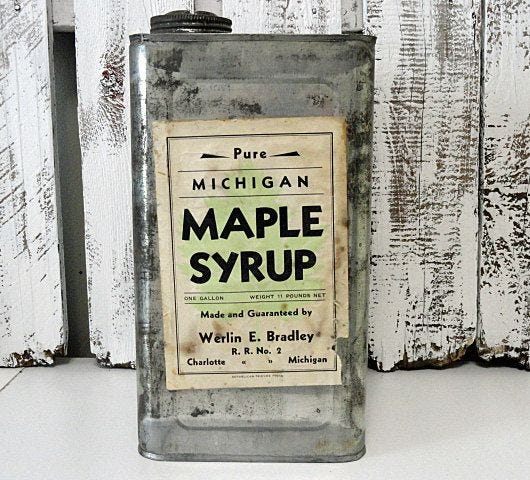
Tin (or metal) cans were traditionally used for maple syrup. They provided a very good barrier against light, air, and moisture, which helped extend shelf life and preserve flavor. However, there is a risk of metallic flavors transferring to the syrup if stored for very long periods. Some sources recommend storing syrup in these containers for no longer than three months.

Why should you care?
Well, the State of Vermont might go out and get you! You see, they apparently audit maple syrup sold in stores—nothing like taxpayers’ money well spent. When a product fails to meet the grade for which it is advertised (or has other quality issues), then the whole lot will be removed from the shelves—by none other than the VAAFM (Vermont Avengers Against Fake Maple, AKA Vermont Agency of Agriculture Food and Markets). I actually saw a report that claimed that 17% of the maple syrup sampled from the shelves was below the advertised grade. This means that one in six bottles fails to meet the grading rules. This statistic applies to physical stores, but it is likely true for online sales as well.

Leave no leaf behind - Maple Grading system
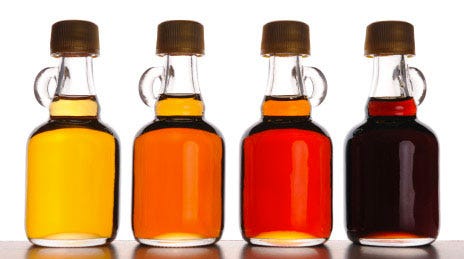
Maple syrup grades are determined by two components: color and flavor (where the flavor corresponds with the color). The darker the syrup, the stronger the flavor. For a syrup to make the grade, it must fall within the color range for that grade and have the proper flavor to match. For example, the golden syrup must be light in color and have a delicate maple flavor. When flavor and color don’t match, the grade is assigned based on the darkest color or strongest flavor. For example, a syrup with a Golden color but a Dark flavor can’t be labeled as Golden; rather, it is labeled as the Dark.
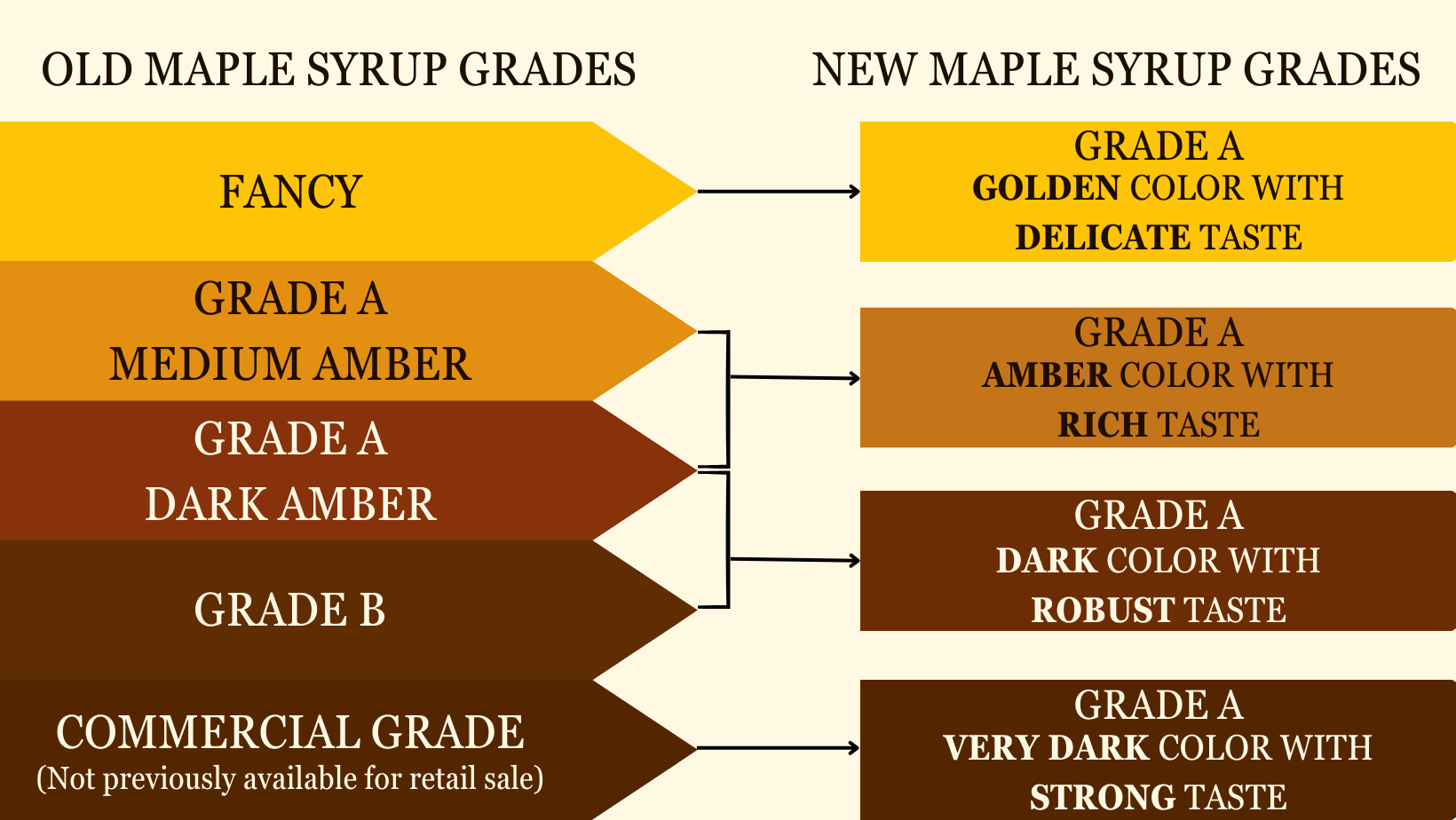
Since 2015, maple producers have used a new grading system. Prior to this system, you would have what today’s ‘Golden’ named Fancy in Vermont (isn’t that fancy?), Grade A Light Amber in New Hampshire, or Canada's No. 1 Light Amber in Quebec. Obviously, this doesn’t help end consumers trying to follow a recipe book.
Beyond the confusion that stems from the naming convention, another reason maple grading was changed was that consumers perceived or assumed that grade B was an inferior quality syrup. In turn, many would seek out grade-A dark when there was no such thing. They might also expect a lower price for Grade B Dark. In reality, grade B is equal in quality to grade A. To solve the problem, everyone got an A for effort.
The IMSI (International Maple Syrup Institute, yes, it’s real, I shit you not) defined the four grades as such:
Grade A Golden Color With Delicate Taste
Usually made at the beginning of the maple season, it has a subtle maple flavor. It is typically used on pancakes and waffles and paired with rich dairy items like yogurt or vanilla ice cream.
Grade A Amber Color With Rich Taste
Usually made mid-season, it’s a very popular classification for all-around use.
Grade A Dark Color With Robust Taste
As the maple season progresses, the syrup darkens in color and develops a more robust maple flavor. It is good for all-around use and works well in baked goods and other recipes where a more concentrated flavor is needed.
Grade A Very Dark Color With a Strong Taste
Produced at the end of the season, it’s perfect for cooking and baking when the maple flavor is desired to be the predominant flavor.
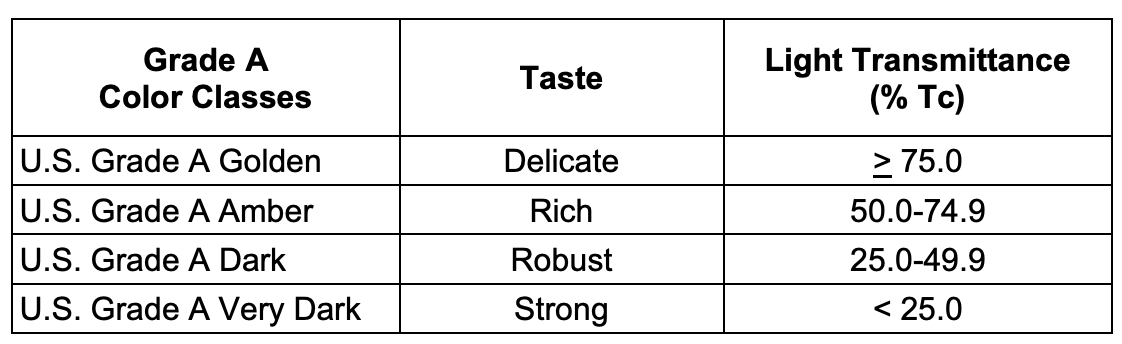
The USDA (United States Department of Agriculture) and FDA actually have a more detailed definition and requirements for Grade A and Processing Grade maple. Processing Grade means any maple syrup that does not meet Grade A requirements but meets the requirement of Processing Grade for use in the manufacturing of other products. Maple syrup for processing must be packed in containers of 5 gallons or 20 liters or larger. Also, Processing Grade maple syrup cannot be packaged in consumer-size containers for retail sales (containers of less than 5 gallons).
The different Grade A classes differ, as mentioned, in flavor and color. But color is a tricky thing to check, isn’t it? Well, apparently not really. The color class of maple syrup is determined by “the percent of light transmission through the syrup as measured with a spectrophotometer using matched square optical cells having a 10mm light path at a wavelength of 560 nm”. The color value is expressed as the percent of light transmission compared to analytical reagent glycerol fixed at 100 percent. Percent transmission is symbolized by “%Tc
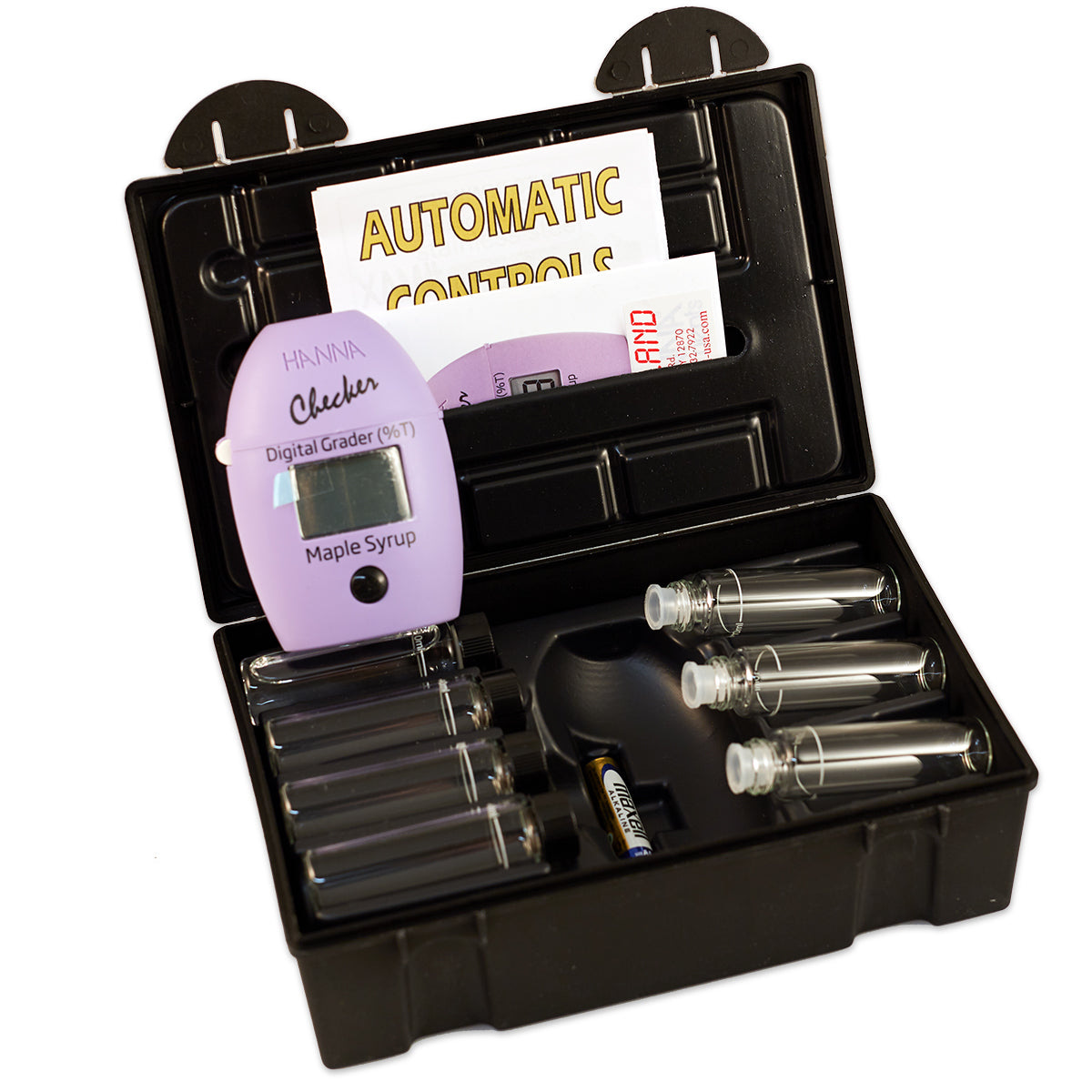
If you fancy doing this test at home, for $92, you can get yourself a home testing kit, run these tests in your local supermarket, and start a class-law suit or something. Obviously, you’ll be left with a ton of product. Side note: maybe it’s just me, but I wonder how big the market is for this device from Hanna—50k units?
A quick pause. I fucking love it. Time and time again, I love how some random product on a supermarket shelf has such a complex industry behind it. That’s exactly why I’m writing about it.
¿Por qué, mamá, por qué? Color and flavor
Why do maple syrup even come in different colors and flavors? This is where we get into the production and the making of maple. First, you need to understand that all four grades are produced the same way, which is by boiling the sap until enough water evaporates, and the maple syrup has a density of 66.9 °Brix at room temperature. Sap is this sticky liquid that contains nutrients and minerals that run through the tree and down to the branches to help generate energy while new buds are forming during springtime.
Brix or Degrees Brix (symbol °Bx) is named after an Adolf. Not the one we are thinking of. That guy pretty much eliminated the name for all other DACH (Germany (D), Austria (A), and Switzerland (CH)) residents. °Bx measures the dissolved solids in a liquid and is commonly used to measure the dissolved sugar content of an aqueous solution (of or containing water). One degree Brix is 1 gram of sucrose in 100 grams of solution and represents the strength of the solution as a percentage by mass.
When it reaches that density (66.9 °Bx), we can call it syrup (it starts happening at around 219-220 oF/ 103.8-104.4 oC boiling temperature). If the production process is the same, why do we have a wide range of colors and flavors? It’s all about the sap, baby.
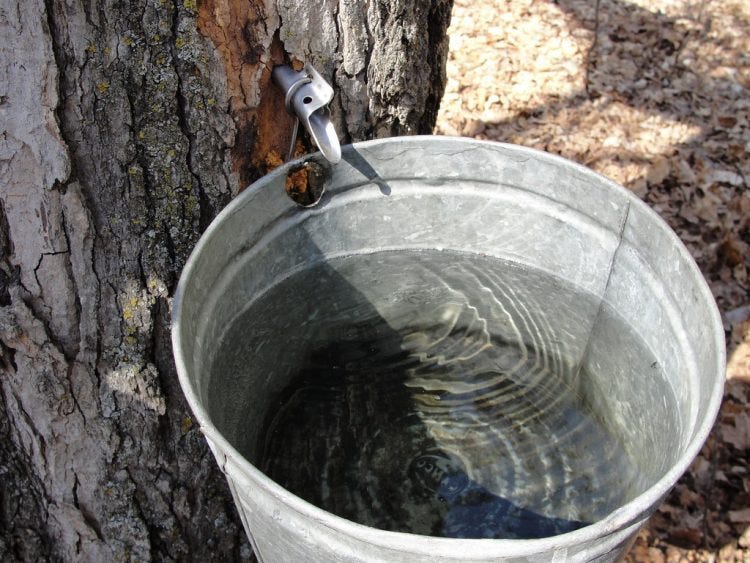
The color of the syrup is influenced by several factors, including the pH of the boiling sap, sugar concentrations, types of sugars in the sap, length of boiling time to produce syrup, temperature outside, and microbial activity. To explain some of these:
The most common form of sugar in sap is sucrose; now, once the sap is outside the tree, the sucrose molecules are exposed to bacteria and yeast that break down sucrose sugars into simpler fructose and glucose sugars. The hotter the air and sap temperature, the more active the microbes, the more sucrose converts. The converted sugars ‘can’ go through a Maillard reaction (aka ‘browning process’) while the bacteria and yeasts die during the boiling process. This process is what connects Ottolenghi, Falafel, and marshmallows together.
Sap with lower pH also breaks down sucrose, which results in more glucose and fructose.
The concentration of sugar in the sap influences boiling time. The higher the content, the shorter the boiling time. When the sap spends less quality time in the evaporator, there is less time for browning to take place.
So, to get golden syrup, you would need sap with little microbial activity (ideally extracted at lower temperatures). As the season goes on, the temperatures rise, causing the sugar content in the sap to decline and microbial activity to increase → giving you the darker-colored syrup.
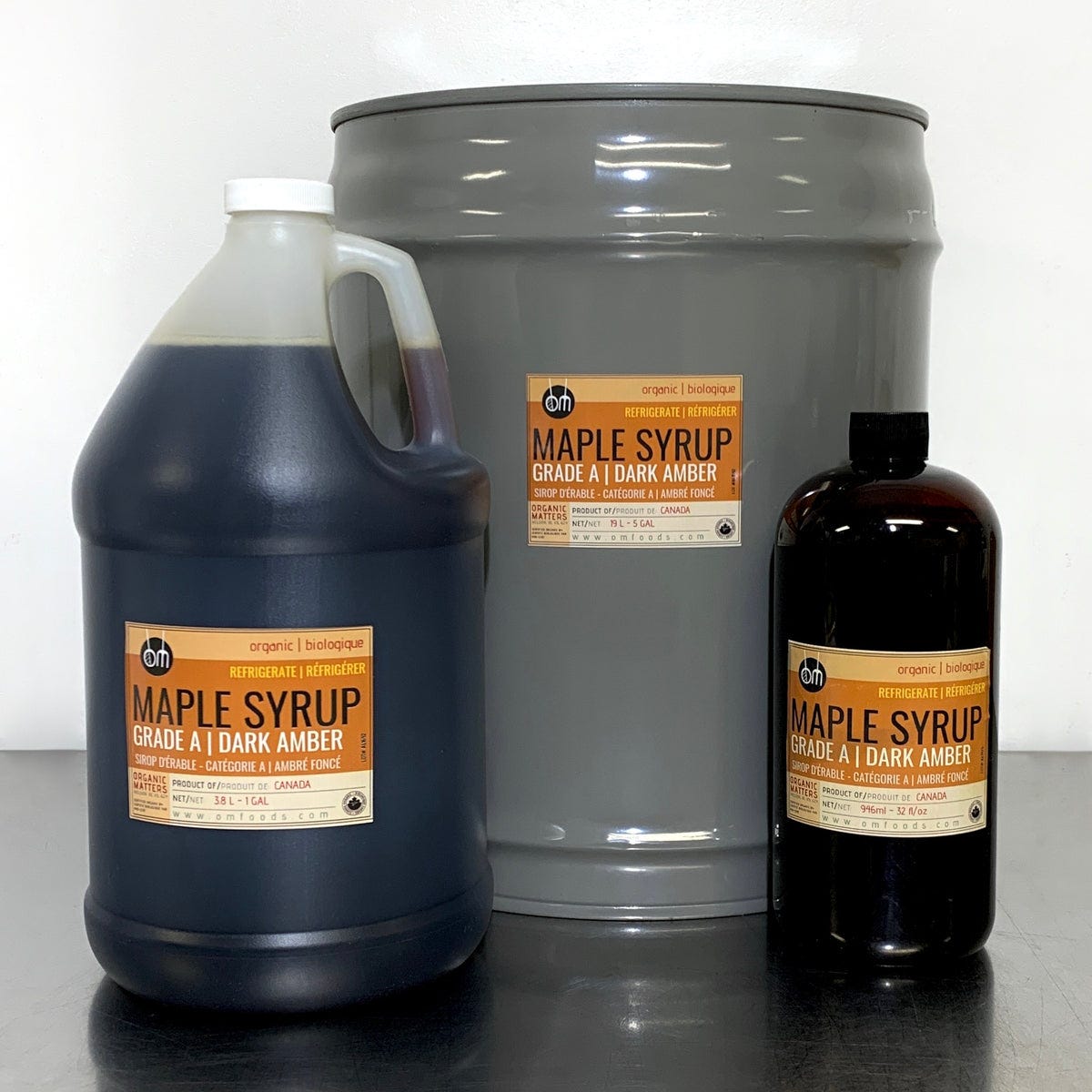
The Flavor. Many people actually prefer the Dark and Very Dark grades because of the strong flavor. Those grades are produced, as you can now understand, later in the season. Because of the lower sugar contents, the boiling time is longer, which enables the flavor to develop. Beyond this, different trees, soils, sap-handling processes, and the weather can all affect the flavor.
How do they actually make the maple syrup? Tap that……….. tree
The exact months/ time can change and is likely to change given global warming, but producers drill holes in the trees in January and February (in some places, it’s actually mid-Feb to mid-March) and insert taps. Most trees will be awarded one to three tabs (depending on size).
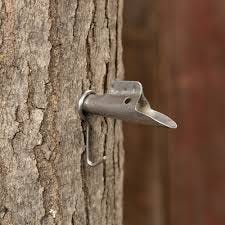
Once that is done, all the trees will be connected by a tubing system that is miles/ kilometers long (in some places, tens/ hundreds long. Yes, hundreds). Some would use buckets or plastic containers instead, but larger producers will have the tubing set up. There’s an entire science on where you can actually drill the taps and how to tap in the year after a harvest. Ideally, you would want to tap at a height that is convenient to work at, but then, if you have already drilled that tree before, you want to keep a 6 to 8-inch distance from any previous drills. The tree’s diameter drives the number of taps:
12-20 inches = 1 Tap
21-27 inches = 2 Taps
Greater than 27 inches = 3 Taps
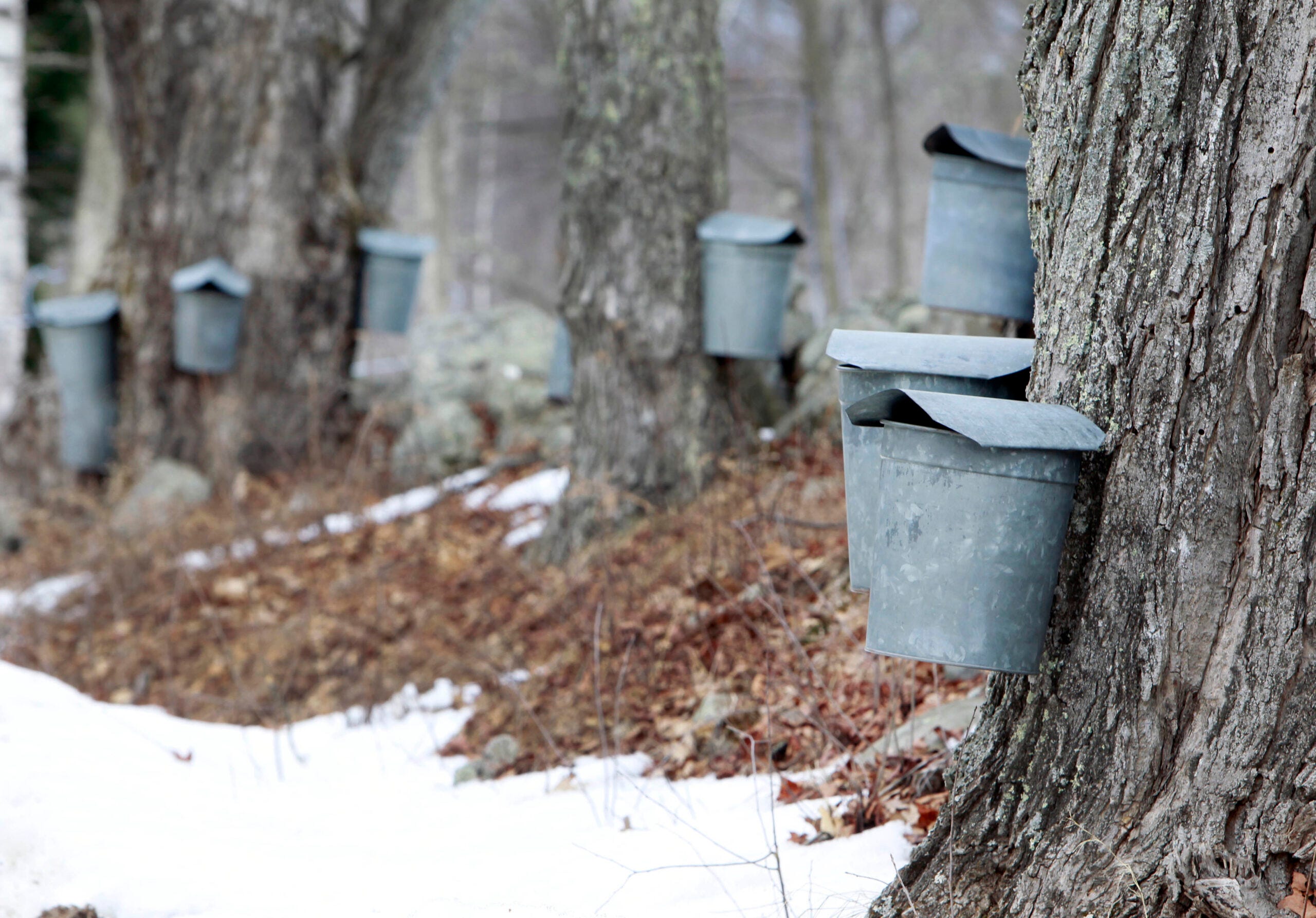
If you drill more than one tap, then you distribute the tap holes around the circumference of the tree. Check this beautiful slow-motion tapping.
The reason this phase is so interesting is that it is done completely by hand. Let that sink in. Imagine you are the Maple Guild out of Vermont, and you own 23 thousand acres of land and 463K trees that you go and drill and connect by hand every year. This is just wild. The Maple Guild is not your standard-size producer, but still, even drilling 3 thousand trees is mind-blowing. Keep in mind that there’s also a running clock where there is a specific time you can start, and there is a specific time you need to finish.
Show me the sap, baby
Sap that can be used for maple syrup comes from only two species: the red maple and the sugar maple tree. The sugar is generated during the summer through photosynthesis. It accumulates in the tree’s roots as starch for the winter. During spring, the sap flows up and down within the tree based on the temperature and night/ day. During the daytime, as temperatures rise, the tree expands, and sap in its branches is subject to pressure, causing it to flow to the trunk. During the night, the wood contracts, squeezing the sap to flow up the tree from its cache in the roots.
The tubing system is connected to each tree, and as mentioned, some might have three. The tubs would connect to larger collection pipes that transfer the sap to the sugar shack either by natural gravity or mechanical pump. From there, the sap would either be processed there or transported by trucks to a separate facility. Gotta love logistics.
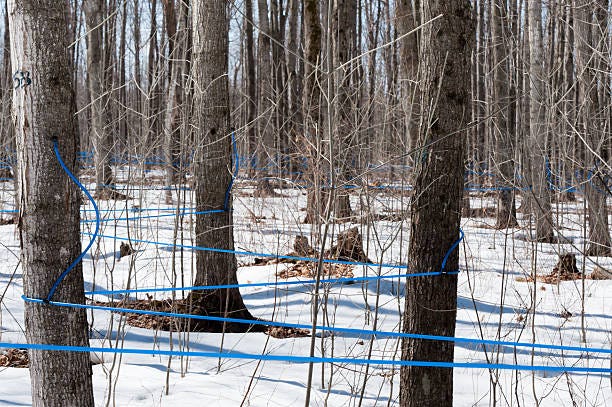
Sap is deposited into stainless steel containers before being pumped into a reverse osmosis system that uses high pressure to reduce the sap’s water content. The more concentrated the sugar content is, the less time you need to evaporate the sap. As I mentioned earlier, this also influences the flavor and grade of the finished product.
What’s reverse osmosis? I remember learning about it while studying the water filtering system on board ships, converting seawater into drinking (and flavorless, in my opinion) water. In maple syrup production, you actually need about 40-43 gallons of sap to produce 1 gallon of syrup. Why is it important? Let’s look at the numbers. If you remember Brix (°Bx) from before, it represents the percent sugar content in maple syrup. Raw sap straight from the tree is about 2% sugar, which is like pure water but with a touch of maple. The maple syrup we pour on pancakes contains approximately 67% sugar. So how do we get from 2% to 68%? Reverse Osmosis.
Small reverse osmosis systems might raise the sugar level from 2% to 4%. That doesn’t sound like much, but the concentrate is twice as sweet as the raw sap. With 4% concentrate, the boiling time would be cut in half, reducing an eight-hour day to four hours. More advanced RO systems today can bring the sap up to 8-16-32 and even to 45%. This enables large producers today to produce a gallon of syrup every 1.6 seconds. Wild.
Let’s vape
Now that we have a more concentrated sap, we must proceed to the final stage before bottling: evaporation. Sap is boiled at 104° C until the sugar content would satisfy Adolf at 66 degrees Brix. During the evaporation of sap, our French man's “Maillard reaction” comes to the rescue. Through the interaction between the amino acids and the sugar, the brown color begins to form. Early in the season, a thick layer of foam often forms on top of the pan, capturing some of the steam. (which is not what you want). For small manufacturers, there are a bunch of tricks on how to dissolve some of it, either by throwing a bit of butter or adding vegetable oil. Both won’t impact flavor. If you're making some at home, you can obviously use a strainer to remove the foam.
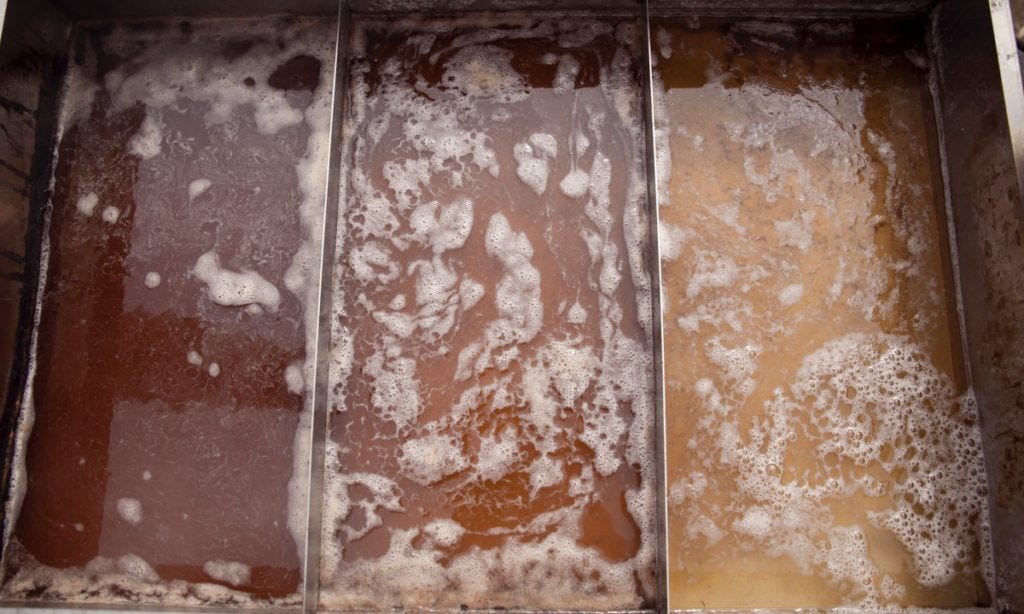
The evaporation process is probably one of the steps where automation kicked in the most. Traditionally, a person would stand before the pan to ensure the maple syrup was discharged on time before proceeding to the next step: filtering and bottling. Some of the systems today automate a lot of the work, such as when to fill the tank, when to stop pouring additional sap into the evaporation tank, when to discharge maple syrup, and most importantly, ensuring that the pan does not burn. If you do, you might have a serious issue that could kill your production volume for that season.
Once the evaporation process is complete, you want to pass the syrup through a filter. That’s it. The final step in the packaging process is bottling and sealing the product. Seal it airtight and use an induction seal under the lid to prevent contamination. Voilà. Slap on a label and the maple bottle will be ready to be shipped.
Money money money…..money…. money money money….. money
As is the case in any industry, the maple industry has seen its fair share of legal disputes. I wanted to write about just a couple of them because, apparently, not everyone who works in the Maple industry is a care bear.

The mafia
It’s a pretty ballsy move to put a maple leaf on your flag. You have to own it, and own it, they do. Canada produces 70% of the world's maple production (although the US is catching up). The interesting piece, though, is that there are hardly any major players who monopolize the market. In the US, it’s a different story, free markets and everything.
In 2014, the Federation of Quebec Maple Syrup Producers (FPAQ) filed a $300,000 lawsuit against Angèle Grenie, a Quebec maple syrup producer from Sainte-Clotilde-de-Beauce, for selling syrup in bulk to a buyer in New Brunswick. That's apparently against the rules of Quebec's maple syrup industry, where producers are subject to a supply management system and a federation that dictates market volume. Also, producers are required to sell to authorized buyers and pay an administrative fee for their output. The federation comprises 13,500 producers and over 40 million taps. Wild.

In January 2016, Grenier and several other producers took their case to the Quebec Court of Appeal, arguing that Quebec maple syrup producers should be able to sell their product independently to other provinces.

The Quebec court declined her appeal, and Grenier appealed to the Supreme Court of Canada, but in June 2017, the court declined to hear her case. In October 2017, she sold her sugar bush to pay both her remaining legal fees ($150K) and an out-of-court settlement with the FPAQ
Mi casa es su casa
Here’s another fascinating story from the Maple Historian. These days, maple syrup comes in different containers of all shapes and sizes. Specialty glass bottles began appearing in the 1980s and became popular in the late 1990s. Among these glass designs, the cabin-shaped bottle has a particularly interesting story. Introduced in 1998 by the Vetrerie Bruni glass company (an Italian manufacturer acquired by Berlin Packaging), this bottle was designed and sold for packaging maple syrup with a plastic or metal screw-on cap.
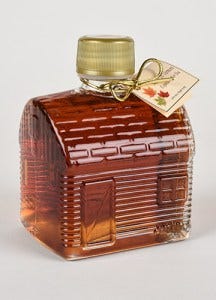
In 2000, this bottle was the center of the maple world's latest drama. Aurora Foods, Inc., the parent company of the Log Cabin Syrup brand, threatened a small Vermont maple syrup company with trademark violations for using a cabin-shaped bottle. Aurora Foods sent letters to both the L.L. Bean company of Maine and Highland Sugarworks out of Vermont threatening cease-and-desist. The letters ordered the companies to stop using the cabin-shaped bottle, destroy all their inventory of the containers, and turn over all profits made from the sale of the syrup in these bottles. Oh yeah, and to dress up as a chicken and sell KFC buckets outside a McDonalds.
Back then, Highland Sugarworks was a small independent maple syrup producer and packing company run by a husband and wife. L.L. Bean was a reseller of Highland Sugarworks’ syrup and, as a nationally known retailer, was probably an easy target. Concerned with protecting their brand, L.L. Bean pulled the cabin-shaped syrup bottles from their shelves and catalog.
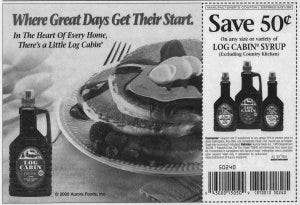
Log Cabin Syrup was being sold in tall and narrow blow-molded plastic bottles with decorative elements that gave it what would probably nobody say: the shape of a log cabin. That said, it did not resemble the small squat cabin shape of the Highland Sugarworks bottle or even the cabin-shaped tins used by the Log Cabin Syrup company years earlier.
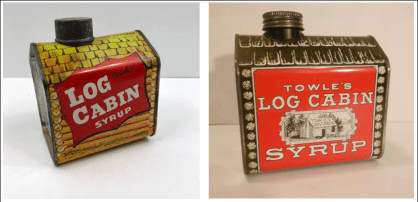
The attack on Highland Sugarworks’ glass cabin design seemed unfounded, given that a metal cabin-shaped tin specifically designed and manufactured for maple syrup had been on the market by the New England Container Company since 1984—no demands were made to the New England Container Company’s metal cabin-shaped can.
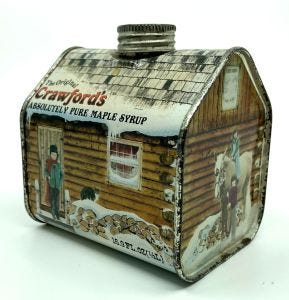
The backlash against Aurora Foods—a large California-based corporation attacking a small Vermont family business—led the company to quickly drop its trademark claims.
Aurora Foods’ situation worsened, suggesting their attack on Highland Sugarworks may have been an attempt to distract from larger internal issues. The same week that Aurora Foods dropped its claim against Highland Sugarworks, it was announced that four of Aurora’s senior executives had resigned and the company was under investigation for serious accounting malpractice. As a result, its stock value plummeted from a normal $19 a share to $3 a share. The CEO subsequently pleaded guilty to fraud in 2001, and the company went into a bankruptcy restructuring in 2002 before merging with Pinnacle Foods in 2004. This marks a bittersweet conclusion.
Epilogue
So now that we know how the bottles and maple syrup are made, I’ll leave you with some parting words. Terrible products can be incredibly interesting, if not for the 10-year-old-looking glass designer who designed the bottle, then at least for the glass manufacturing process and the innovation coming to the maple syrup production facilities.
I love how products never exist in a void; there’s always a bigger story behind how they are designed, manufactured, used/ abused, and sold. I know next time I go down the aisle of a local supermarket and see that crappy, dysfunctional bottle, I will have much more appreciation for the journey the bottle and its content took to get there.
Random stuff I saw while learning about maple
This collective of small family farms in the hills of Vermont has a great website that details maple production and covers a ton of interesting pieces. They sell maple, and it’s all about supporting small family businesses. A big bonus: their bottles make sense.
The video from Chow gives a tip that would change your life, or at least that of your maple syrup bottle. No more stuck lids. Give it a try.
If you want to see a longer video on glass bottle manufacturing, check out this video. Highlights the different glass blowing and the processing that takes place before and after.
While preparing this piece, I found one of the most complete, interesting, and detailed videos about the collection and production from sap to table.
This dashboard from the Vermont Agency of Agriculture Food and Markets shows many interesting statistics about maple consumption.
Cornell has a maple program, and they published a beginner guide to maple syrup production.
In this video, you get an explanation of how to run grading tests using manual and digital tools
If you’re considering a career in the maple industry, check out this technical guide to build a solid foundation for the harvesting process.
This guy writes so many fascinating stories about the history of maple.
Let me know your thoughts and what terrible products I write about next.
I am a small maple syrup producer in Ontario, Canada with 3 years of experience. If you are going to post a photo of an old fashioned spigot...use it beside a photo of pails for maple collection...The pipeline people use plastic spiles of a different design. To mix and match is misleading.
We fill each bottle individually and I have found the round circle is useful for holding the bottle during filling as it doesn't get as hot and so prevents my fingers from getting scaled. :)